Choose a first case you can both get into
Before you start, agree on the kind of evening you want. Do you enjoy slow reading and comparing documents, or would you rather move quickly between locations? Are you comfortable with suspense and a missing-person premise? Reading the case description together helps you choose a story that suits both players.
Intro Case is the free introductory case in Case 34. Its current guide length is around 35–50 minutes, though your pace will depend on how much you discuss and explore. Treat the estimate as room for a story, rather than a deadline to beat. The tutorial introduces the game’s tools as you investigate.
Set up one shared investigation
Open the case library and select a case. Choose ‘Co-op,’ enter your name and create a room. Share the room code with the other player. They can open the same game in their browser, choose Co-op, select ‘I already have a room code,’ and enter the code and a different name. Rooms support up to five investigators, so you can also invite more friends.
You can play from different places. If you are apart, keep a voice call open so you can compare what you are reading; the game’s shared progress does not replace your conversation. If you are sitting together, two screens can let you examine different materials at the same time. One shared screen also works if you take turns choosing the next action.
Share the discovery, not just the controls
An easy way to begin is to let one player navigate while the other reads and asks questions. Swap those roles after a few visits. The purpose is to keep both people involved, not to assign one person permanent responsibility for every clue.
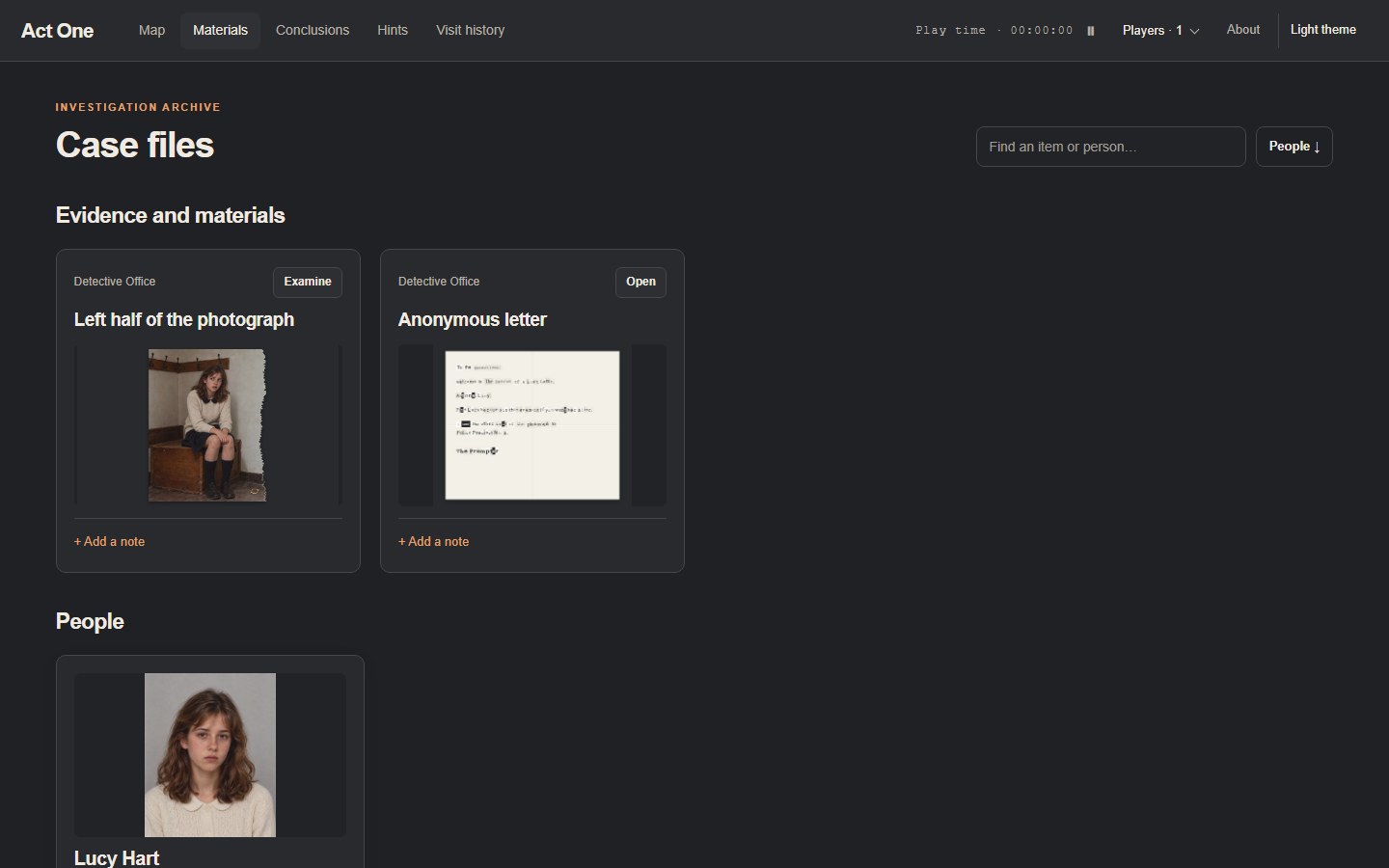
When you open something important, say what you found and where you found it. ‘There is a different date on the letter’ invites a second look. ‘I’ve solved it’ can close the conversation too early. Give your partner the source and let them check the connection.
Make disagreements useful
If you have different suspects or explanations, keep both possibilities alive for a while. Write down what each theory predicts and identify the next piece of evidence that could separate them. You may discover that you agree on the facts but disagree about what those facts imply.
Try these questions when the conversation starts circling:
- Which part of this theory is directly supported by a source?
- What would we expect to find if this explanation were true?
- Is there another way to explain the same clue?
- What can our next visit actually help us check?
Pause before either of you loses the thread
Reading tired is an easy way to miss context. Use the pause control when you need a break, then briefly recap your current question before continuing. Keep your room code available so you can return to the same investigation.
If both of you are stuck on the same obstacle, decide together whether to use a hint. Agreeing on that choice is more enjoyable than having one player quietly look up an answer while the other is still investigating.
Write a conclusion together
Before submitting, each player should have a chance to explain the case. Compare the answers you intend to give and point to the evidence behind them. If one explanation feels incomplete, revisit the relevant material instead of settling the argument by confidence alone.
Once you finish, use the explanation as a conversation starter. Which clue changed your mind? What did your partner notice that you overlooked? You do not need matching instincts to make a good team. The point is to build a stronger explanation together. Start with Intro Case and find out how the two of you investigate.
Put your curiosity to work
Your first case is free.
Meet the Prompter in Intro Case, a complete introductory investigation. Play solo or in co-op with up to five players.
Choose Intro Case →