Begin with what the source actually says
Read the full document before choosing the sentence that seems to confirm your theory. Notice who created it, who was meant to read it and what kind of record it is. A personal letter, a witness’s account and an official report can describe the same event from different positions.
For a practice example unrelated to the game’s solution, imagine a witness says a visitor arrived ‘after the shop closed.’ That statement does not give you an exact arrival time until you know when the shop closed that day. The missing context is a question to investigate, not a blank to fill with an assumption.
Keep facts, claims and theories separate
A fact is a detail you can identify in the material. A claim is something a person or source tells you. A theory is the explanation you are building from those details. These categories can overlap as you find support, but treating them as interchangeable makes it harder to spot a weak link.
Write a short note in three parts: the detail, its source and what it might mean. ‘The receipt lists an evening time; found in the desk; may help check the journey’ gives you more room to think than ‘The receipt proves the suspect is innocent.’ Keep your language open until the evidence earns a stronger conclusion.
Build a timeline with honest gaps
Put events in order using the times and relative descriptions you actually have. Preserve phrases such as ‘before the call’ when no exact time is given. An uncertain interval is still useful: it can show you which account needs a second look.
Do not make the timeline more precise than its sources. Distinguish when something happened from when it was reported or written down. A later record may describe an earlier event, and the difference can matter. If two entries conflict, keep both visible until you understand why.
Compare independent details
When two accounts agree, ask whether they are independent. Two people repeating the same story may still be relying on a single source. A detail supported by a separate document or observation can give you a different kind of confidence.
In your case files, place the sources side by side in your thinking. What matches? What differs? Does the disagreement concern the event itself, a time, a person’s interpretation or something they could not have seen? Look for the smallest checkable question before deciding which whole account to trust.
Read photographs as carefully as text
Open a photograph at a useful size and examine the scene before interpreting its mood. Start with visible objects, positions and relationships. A photograph may show that two things were near each other; it may not explain why they were there.
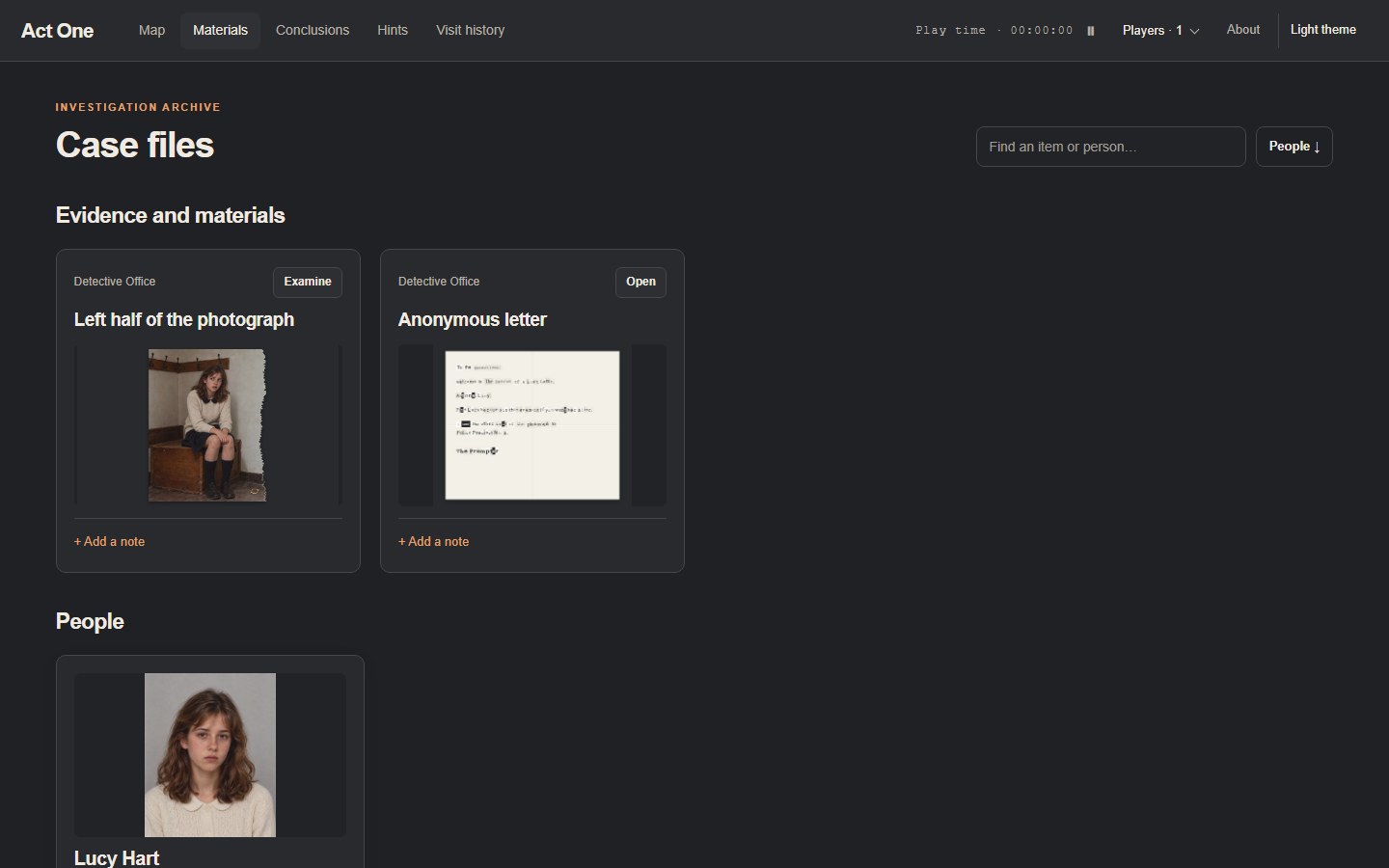
In Case 34, you can open the photographs and documents you collect, save useful text selections and return to your materials while considering a new lead. Use those tools to keep the source close to the theory. If you cannot remember a detail clearly, look again rather than letting a convenient memory become evidence.
Try to challenge your favorite explanation
Once a theory begins to fit, spend a moment looking for what would make it fail. Is there a source you have ignored because it is inconvenient? Are you treating a motive as proof of an action? Does the proposed sequence leave time for everything you say happened?
A short review can help:
- Identify the strongest source supporting the theory.
- Name the assumption doing the most work.
- Find a plausible alternative for one important clue.
- Check the source most likely to settle that uncertainty.
Use the final questions to test your reasoning
A case’s conclusion should make you explain the connections. Return to the questions and check whether your answers cover what they actually ask. A compelling theory that answers a different question still needs work.
You do not have to inspect every imaginable detail before you can have a useful explanation. You do need to know which evidence supports your answers and where your uncertainty remains. To practice these habits in a complete introductory story, choose Intro Case from the Case 34 case library.
Put your curiosity to work
Your first case is free.
Meet the Prompter in Intro Case, a complete introductory investigation. Play solo or in co-op with up to five players.
Choose Intro Case →